


Application boundary: This page helps a professional buyer prepare a qualification brief. It is not agronomic advice, a crop recipe, a certification, or a performance guarantee. Final suitability is decided by the buyer through its own technical review and representative trial.
Coconut coir can be used as a support substrate in some hydroponic systems, but the word “hydroponics” does not define one universal material specification. A buyer should state the crop, system, container, fertigation water, drainage target, particle structure, EC and pH methods, hydration procedure, and the trial used to approve the material.
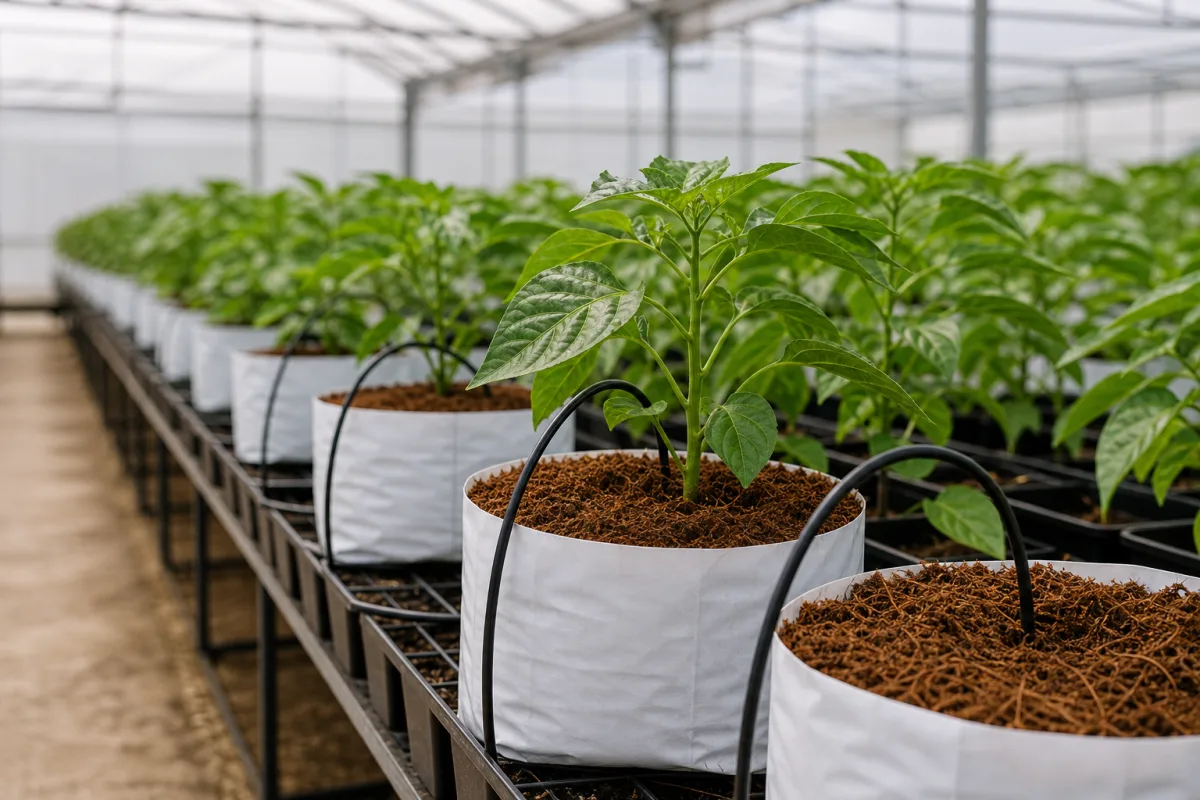
Start with the hydroponic system, not with a generic grade name
Net pots, troughs, slabs, bags, and containerized drip systems expose the root zone to different volumes of substrate, irrigation frequency, oxygen conditions, and drainage. The required particle distribution and water-air balance should therefore come from the grower or substrate formulator. Coco Export Indo supplies compressed 5kg blocks; it does not design the crop program or promise a yield outcome.
System and crop
Record the crop, production stage, container volume, root-zone depth, irrigation delivery, drainage collection, and reuse policy.
Chemistry method
Define source-water quality, EC extraction ratio, pH method, sample conditioning, reporting unit, target, tolerance, and retest rule.
Physical structure
Specify the required fine and coarse fractions, foreign-material limit, expansion procedure, bulk density basis, and air-water evaluation.
Trial acceptance
Approve a representative lot in the actual irrigation and nutrient program, then document the observations and authority to release the order.
Questions to put in the application-specific RFQ
Use this table to turn an intended use into measurable supplier and buyer responsibilities. Omit a field only when it is genuinely irrelevant and both parties understand why.
| Decision point | What the buyer should define |
|---|---|
| Crop and production stage | State crop, propagation or production stage, cycle length, and the operator responsible for agronomic approval. |
| System and container | Describe net pot, bag, trough, slab, or other container; include volume, drainage openings, and filling method. |
| EC and pH | State the test method, water basis, extraction ratio, target, tolerance, sample identity, and decision point. |
| Particle profile | Define fines, chips or coarse fraction, screening basis, and the method used to assess physical consistency. |
| Hydration and expansion | Fix water volume, soak time, breakup method, draining step, and measurement timing. |
| Packing and evidence | Confirm block wrap, buyer marks, pallet plan, lot identity, reference or order test, and receiving records. |
Build a hydroponic validation plan before commercial scale
First compare the supplied reference with the buyer’s written method. Then expand a representative sample using the intended water and handling sequence. Evaluate the material in the real container and irrigation schedule, not only in a laboratory beaker. Record drainage behaviour, structural stability, chemistry results, and any changes made to fertigation. The responsible grower or technical adviser should decide whether the system-level trial is acceptable.
- Define the production context — Send the crop, system, water analysis, nutrient-management responsibility, container, drainage, and planned volume.
- Write measurable incoming limits — Agree chemistry methods, physical profile, moisture, expansion, foreign matter, sampling, tolerance, and packing.
- Run a representative trial — Use the intended hydration, irrigation, nutrient, and drainage practice; keep the sample identity and observations.
- Release through written documents — Confirm the accepted specification, quotation, packing, evidence, destination, and receiving procedure before ordering.
How the two active 5kg grades enter the discussion
| Active grade | Application-planning boundary |
|---|---|
| 5kg block — Low EC | The active 5kg low-EC block has a published EC reference below 0.6 mS/cm, pH 5–7, moisture 10–20%, and listed MOQ of 10 MT. The method and order tolerance still require written confirmation. |
| 5kg block — High EC | The active 5kg high-EC block has a published EC reference above 0.7 mS/cm. A buyer considering downstream washing, conditioning, or blending must own and validate that process; high EC is not presented as direct-use hydroponic media. |
Receiving inspection and change control
At receipt, keep lots separated and labels traceable. Sample using the agreed plan, repeat the written hydration and extraction methods, and compare results with the accepted tolerance. Do not change the method after seeing a result. If a result is outside the decision rule, follow the agreed retest and escalation process before the material enters production.
For every order, confirm the sampling unit, sample count, preparation, test methods, tolerance, retest rule, evidence type, and the people authorized to accept, hold, or reject material. Review the document and analysis guide and MOQ and shipping terms before closing the quotation.
Independent technical references
These independent sources explain application context; they do not verify Coco Export Indo products or replace the buyer’s specification and trial.
- University of Minnesota Extension — Small-scale hydroponicsLists coconut coir among common hydroponic substrates and notes both water retention and product variability.
- Oklahoma State University Extension — Soilless Growing MediumsExplains hydroponic media functions and the variability, hydration, and moisture behaviour associated with coconut coir.
Frequently asked questions about cocopeat for hydroponics
Is low-EC cocopeat automatically suitable for every hydroponic crop?
No. EC is one incoming variable. Crop, water, nutrient program, particle structure, container, irrigation, drainage, and an actual system trial remain buyer responsibilities.
Which EC value should be written in the RFQ?
Write the target together with the extraction ratio, preparation, water specification, reporting unit, sample basis, tolerance, and retest rule. A number without a method is incomplete.
Can the high-EC block be washed after delivery?
A buyer may propose a downstream process, but it must define water quality, contact time, drainage, sampling, final limits, waste handling, and responsibility. Coco Export Indo does not guarantee an unverified buyer process.
What should a hydroponic buyer send for a quotation?
Send crop and system context, selected grade, methods and limits, particle requirement, block quantity, packing, destination, documents, trade term, and target timing.
Compare related application guides
Prepare an application-specific quotation request
Send the intended application, active grade, test methods and limits, physical requirement, quantity, packing, destination, document list, trial need, and target timing. Unknown points can remain open for written clarification.