


Application boundary: This page helps a professional buyer prepare a qualification brief. It is not agronomic advice, a crop recipe, a certification, or a performance guarantee. Final suitability is decided by the buyer through its own technical review and representative trial.
A nursery typically manages several crop groups, container sizes, irrigation zones, and production durations. Cocopeat may be assessed as a substrate component, but the buyer should define how it contributes to water retention, drainage, aeration, fill consistency, weight, and handling. The nursery remains responsible for formulation and crop management.
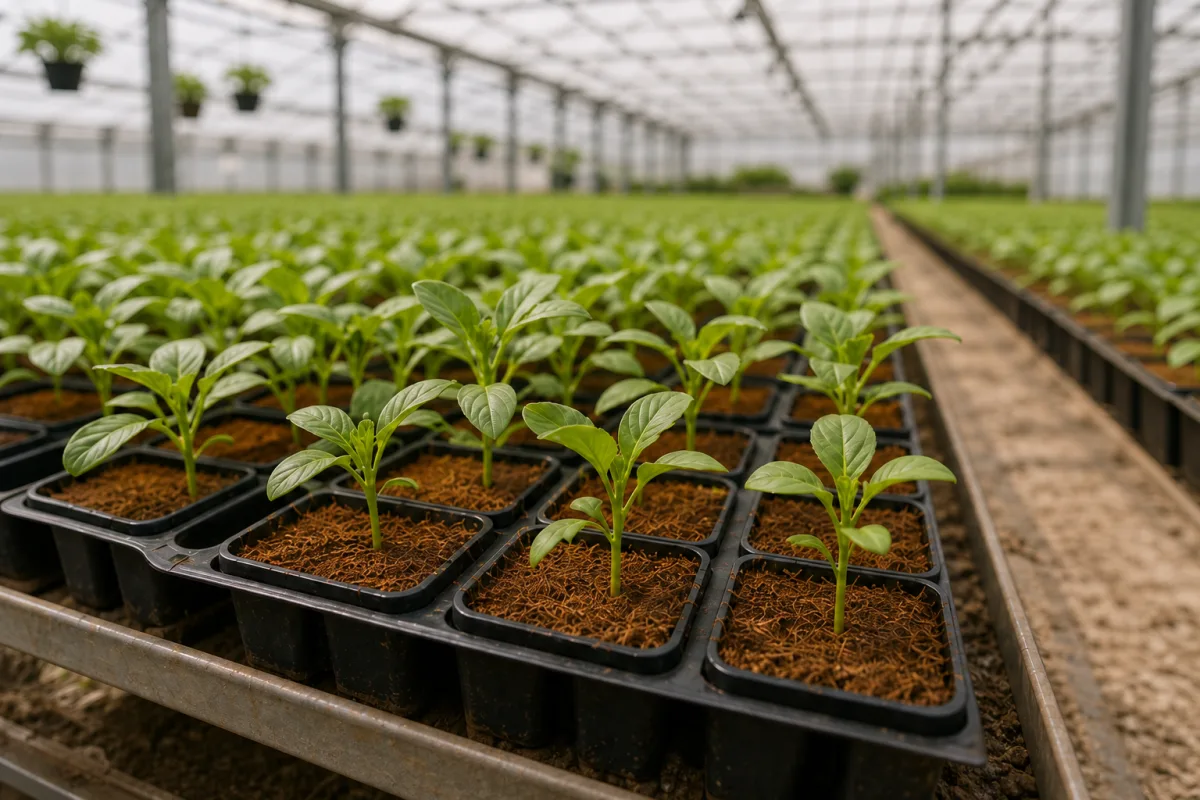
Group nursery requirements before writing one specification
A propagation liner, small annual, woody ornamental, and long-cycle container crop may not need the same substrate structure or irrigation program. Begin by grouping similar crops and containers. For each group, document irrigation delivery, fertilizer strategy, production duration, overwintering or holding conditions, transplant handling, and the physical and chemical tests used to manage the root zone.
Crop grouping
Separate propagation, short-cycle, woody, ornamental, or other nursery groups when container, irrigation, duration, or acceptance differs.
Container and fill
State pot or cell dimensions, filling equipment, compaction risk, target fill weight, drainage openings, and handling requirements.
Irrigation zones
Describe water source, delivery uniformity, irrigation frequency, leaching strategy, monitoring locations, and response to out-of-range results.
Change control
Define reference material, approved trial, lot identity, retained sample, formula change review, receiving test, and decision authority.
Questions to put in the application-specific RFQ
Use this table to turn an intended use into measurable supplier and buyer responsibilities. Omit a field only when it is genuinely irrelevant and both parties understand why.
| Decision point | What the buyer should define |
|---|---|
| Crop and duration | Group crops by container, production duration, irrigation, nutrition, and transplant or sale requirement. |
| Container and machinery | Provide dimensions, fill line or manual process, target weight, compaction concerns, and drainage configuration. |
| Physical properties | Define particle distribution, fines limit, expansion, air space or water-holding evaluation, and structural stability. |
| Chemistry | State EC and pH procedures, irrigation-water context, incoming tolerance, and any formulation-side nutrient responsibility. |
| Monitoring | Define sampling locations, pour-through or other nursery method, frequency, trend review, and corrective-action owner. |
| Commercial scope | Confirm grade, block quantity, packing, pallet plan, lot marks, destination, documents, and target schedule. |
Treat the nursery as several controlled production zones
Nursery monitoring is more useful when repeated on representative containers within consistent irrigation zones. Record the same containers or sampling pattern, compare trends, and interpret EC and pH together with irrigation water, fertilizer, crop condition, and container moisture. A supplier’s incoming value cannot diagnose every nursery production issue.
- Create crop-container groups — Map crop category, container size, duration, irrigation zone, fertilizer program, and the operational owner for each use.
- Write component requirements — Set physical profile, expansion, moisture, chemistry methods, foreign matter, packing, sampling, and allowable variation.
- Blend or use in a controlled trial — Run the intended formulation and filling process, then monitor representative containers through an agreed period.
- Approve and monitor change — Link the approved reference to lot records, receiving inspection, formula control, retained samples, and supplier communication.
How the two active 5kg grades enter the discussion
| Active grade | Application-planning boundary |
|---|---|
| 5kg block — Low EC | A low-EC block may reduce one source of soluble-salt variability when the nursery requires that input. The published reference below 0.6 mS/cm does not replace formulation trials, irrigation-water review, crop-group limits, or ongoing nursery monitoring. |
| 5kg block — High EC | A high-EC block should be considered only where the nursery or substrate blender has a defined use and any conditioning process has been validated. The published grade above 0.7 mS/cm is an incoming product reference, not a finished nursery mix specification. |
Receiving inspection and change control
Keep block lots dry, marked, and separated. Inspect wrap and visible condition, then sample with the accepted plan. Expand and test material with the stated method before blending or filling. If the nursery changes container size, formula, water source, irrigation equipment, fertilizer, or crop group, decide whether the prior approval remains applicable.
For every order, confirm the sampling unit, sample count, preparation, test methods, tolerance, retest rule, evidence type, and the people authorized to accept, hold, or reject material. Review the document and analysis guide and MOQ and shipping terms before closing the quotation.
Independent technical references
These independent sources explain application context; they do not verify Coco Export Indo products or replace the buyer’s specification and trial.
- NC State Extension — Plants Grown in ContainersExplains the substrate functions of drainage, aeration, water retention, weight, fertility, and container management.
- NC State Extension — Pour-Through Extraction ProcedureDescribes repeatable pH and EC monitoring across representative nursery containers and irrigation zones.
Frequently asked questions about cocopeat for nurseries
Can one cocopeat specification cover an entire nursery?
Only if the nursery has shown that the same requirement works across its relevant crop, container, irrigation, duration, and formulation groups. Otherwise, separate briefs or trials are safer.
Why should container-filling equipment be included in the RFQ?
Filling and compaction can change bulk density, pore structure, drainage, and unit consistency. The buyer should describe the actual process used to prepare containers.
Does incoming EC replace nursery leachate monitoring?
No. Incoming and in-production measurements serve different decisions. Nursery monitoring reflects water, fertilizer, irrigation, crop uptake, container, and environmental conditions together.
What information helps quote a nursery order?
Send crop groups, intended formulation or use, grade, physical and chemical methods, quantity, packing, destination, required documents, trial plan, and schedule.
Compare related application guides
Prepare an application-specific quotation request
Send the intended application, active grade, test methods and limits, physical requirement, quantity, packing, destination, document list, trial need, and target timing. Unknown points can remain open for written clarification.