


Application boundary: This page helps a professional buyer prepare a qualification brief. It is not agronomic advice, a crop recipe, a certification, or a performance guarantee. Final suitability is decided by the buyer through its own technical review and representative trial.
Seedling production places a premium on uniform filling, moisture distribution, aeration, low salt risk, and repeatable emergence. Cocopeat may be evaluated as a propagation-medium component, but the buyer must define crop sensitivity, tray cell size, particle distribution, EC and pH methods, wetting, sanitation, fertility timing, and a germination or propagation trial.
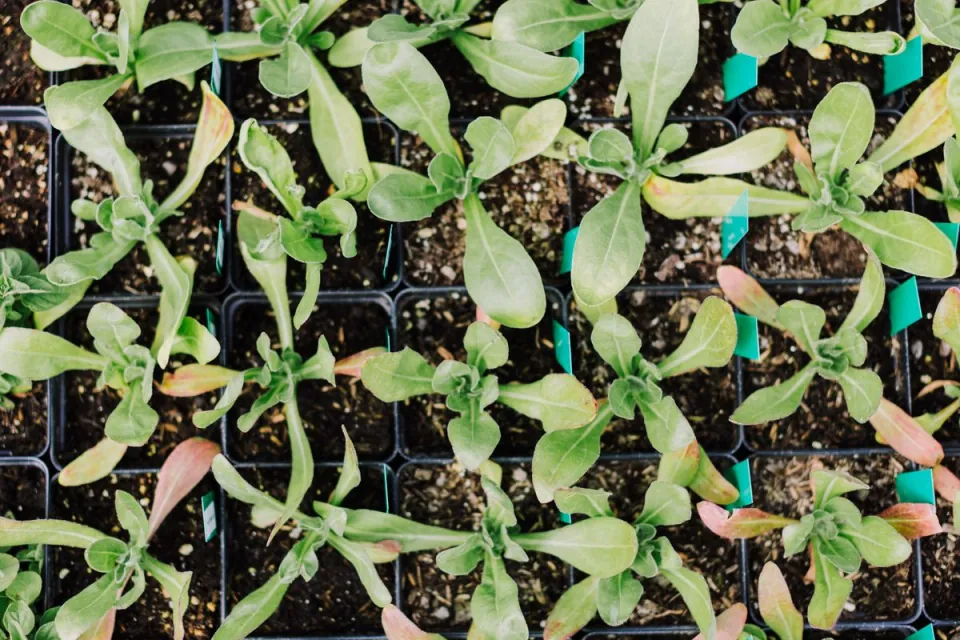
Design the brief around the seed, cell, and early root system
Small cells magnify variation in particle size, compaction, wetting, drainage, and soluble salts. A coarse fraction that works in a large container may disrupt small-cell filling; excessive fines or compaction may reduce air space. The buyer should state seed size, crop sensitivity, cell dimensions, sowing equipment, irrigation method, environment, and the point at which seedlings are transplanted or sold.
Seed and cell
Record crop, seed size, germination expectations, cell dimensions, sowing depth, filling equipment, and transplant stage.
Fine-particle control
Define screening or particle profile, fines and oversized material limits, foreign matter, fill uniformity, compaction, and surface consistency.
Moisture and chemistry
Set wetting procedure, drainage, EC and pH methods, water quality, incoming tolerance, and responsibility for fertilizer after emergence.
Propagation trial
Compare representative material with the nursery reference using the same seed lot, tray, environment, irrigation, observations, and release criteria.
Questions to put in the application-specific RFQ
Use this table to turn an intended use into measurable supplier and buyer responsibilities. Omit a field only when it is genuinely irrelevant and both parties understand why.
| Decision point | What the buyer should define |
|---|---|
| Crop and seed | State crop, seed or cutting context, sensitivity, expected production window, and the technical approval owner. |
| Tray or plug | Provide cell dimensions, number of cells, fill method, sowing equipment, irrigation delivery, and transplant stage. |
| Particle profile | Define fine and coarse fractions, oversized pieces, foreign matter, screening basis, fill uniformity, and compaction risk. |
| EC and pH | Use the written extraction method, water specification, target, tolerance, sample plan, and retest decision. |
| Moisture and wetting | Set incoming moisture, hydration or pre-wetting, mixing sequence, tray filling, drainage, and storage after preparation. |
| Trial evidence | Define seed lot, replicate trays, reference medium, observation schedule, emergence and handling criteria, and release authority. |
Use a controlled germination or propagation comparison
A useful trial controls the factors outside the substrate: seed lot or plant material, tray, filling, sowing depth, water, temperature, light, humidity, sanitation, and observation timing. Compare against an accepted reference rather than an undefined expectation. Record emergence, uniformity, moisture behaviour, root handling, and any visible problem without converting one trial into a universal crop guarantee.
- Define the propagation system — Document crop, seed or cutting, cell size, equipment, environment, irrigation, fertilizer timing, sanitation, and transplant point.
- Write tight incoming controls — Agree particle profile, moisture, EC and pH methods, foreign matter, expansion, packing, sampling, and lot identity.
- Run a controlled comparison — Use the same seed lot and operating conditions for the candidate and accepted reference; record observations at fixed times.
- Approve the production lot — Connect trial approval to order specification, lot evidence, receiving inspection, retained sample, and change control.
How the two active 5kg grades enter the discussion
| Active grade | Application-planning boundary |
|---|---|
| 5kg block — Low EC | The published low-EC reference below 0.6 mS/cm may be a relevant starting point for a salt-sensitive propagation brief, but the buyer must define the method, tolerance, particle requirement, complete formulation, and crop-side trial. |
| 5kg block — High EC | The high-EC block is not presented as direct seed-starting media. If a formulator proposes a processed or blended use, it must validate the conditioning process and the final medium before propagation. |
Receiving inspection and change control
Inspect moisture, wrap, marks, lot separation, visible contamination, and foreign material. Use the accepted expansion and sampling method, then test chemistry and particle consistency before preparing production trays. Hold material from use when the lot identity or result cannot be reconciled with the approved order documents.
For every order, confirm the sampling unit, sample count, preparation, test methods, tolerance, retest rule, evidence type, and the people authorized to accept, hold, or reject material. Review the document and analysis guide and MOQ and shipping terms before closing the quotation.
Independent technical references
These independent sources explain application context; they do not verify Coco Export Indo products or replace the buyer’s specification and trial.
- University of Minnesota Extension — Starting Seeds IndoorsExplains why lightweight, clean, appropriately textured and porous soilless media are used for germination and small seedlings.
- Penn State Extension — Potting Media and Plant PropagationDiscusses propagation-media testing, salt risk, pH and EC methods, and controlled bioassays for unfamiliar mixes.
Frequently asked questions about cocopeat for seedlings
Is a 5kg cocopeat block ready to fill seedling trays directly?
Not automatically. The buyer must define expansion, screening or formulation, particle profile, wetting, chemistry, filling, sanitation, and crop-specific trial acceptance.
Why is particle profile especially important for seedlings?
Small cells have limited volume. Oversized pieces, excessive fines, or inconsistent compaction can affect filling, moisture distribution, aeration, sowing depth, and root handling.
Should fertilizer be included in the cocopeat specification?
The order should state what the supplied material includes and who owns the final formulation. Fertility timing and crop nutrition remain the grower or formulator’s responsibility unless specifically agreed.
What should a propagation buyer send for pricing?
Send crop and tray context, grade, particle and chemistry methods, required quantity, packing, destination, documents, trial requirement, and schedule.
Compare related application guides
Prepare an application-specific quotation request
Send the intended application, active grade, test methods and limits, physical requirement, quantity, packing, destination, document list, trial need, and target timing. Unknown points can remain open for written clarification.