


Application boundary: This page helps a professional buyer prepare a qualification brief. It is not agronomic advice, a crop recipe, a certification, or a performance guarantee. Final suitability is decided by the buyer through its own technical review and representative trial.
A potting-mix manufacturer should specify cocopeat as a component with a defined function inside the complete formula. The incoming brief should connect particle distribution, moisture, expansion, bulk handling, EC and pH methods, foreign matter, storage, blending, and change control with finished-mix physical, chemical, crop, packaging, and labeling requirements.
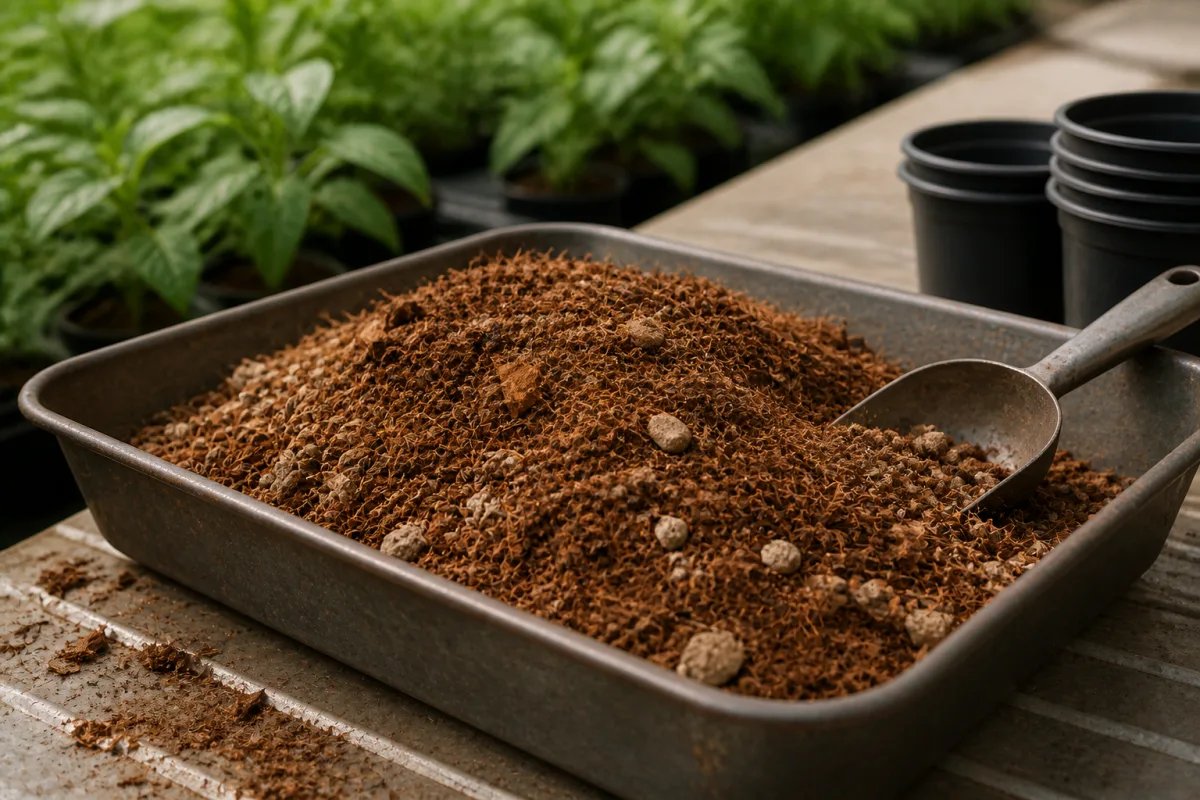
Define what cocopeat must contribute to the complete formula
Cocopeat may be considered for water retention, structure, weight, or another formulation objective, but its percentage and interaction with bark, peat, compost, perlite, vermiculite, fertilizer, lime, wetting agents, and other components must be validated by the formulator. An incoming component specification is not a finished potting-mix claim.
Formula function
State the cocopeat percentage range, intended role, other components, target customer or crop group, and the owner of formulation approval.
Physical balance
Define particle profile, expansion, bulk density basis, air space, water-holding or container-capacity method, drainage, and stability.
Chemical compatibility
Fix EC and pH methods, water and alkalinity context, nutrient or lime responsibility, tolerance, and finished-mix test plan.
Manufacturing control
Document receiving lots, storage, dosing, mixing order, moisture adjustment, sampling, finished-product release, and supplier change review.
Questions to put in the application-specific RFQ
Use this table to turn an intended use into measurable supplier and buyer responsibilities. Omit a field only when it is genuinely irrelevant and both parties understand why.
| Decision point | What the buyer should define |
|---|---|
| Formula role | State intended percentage range, functional objective, other components, finished product, customer, and claim owner. |
| Particle distribution | Define fines and coarse fractions, screening method, foreign matter, expansion, bulk density basis, and allowable variation. |
| EC and pH | Set incoming methods and tolerances, irrigation-water or test-water basis, and the finished-mix chemistry procedure. |
| Process behaviour | Describe storage, dosing, pre-wetting, blending order, equipment, mixing time, moisture adjustment, and packaging line. |
| Finished-mix release | Define physical, chemical, crop or bioassay, fill, weight, label, retained-sample, and shelf-monitoring requirements. |
| Supply and packing | Confirm selected grade, quantity cadence, block wrap, pallet plan, lot marks, destination, documents, and forecast process. |
Qualify both the component and the finished potting mix
Incoming tests confirm whether cocopeat matches its purchase specification. Finished-mix tests confirm whether the complete formula and manufacturing process meet the formulator’s own targets. Keep those decisions separate. A change in source, particle distribution, moisture, blend percentage, other component, equipment, water, fertilizer, or packaging may require a new comparison and release decision.
- Set the formula objective — Define finished-product customer, crop or use, component functions, target properties, claims, and responsibility for formulation.
- Write incoming component limits — Fix particle profile, moisture, expansion, EC and pH methods, foreign matter, tolerance, sampling, packing, and evidence.
- Run process and finished-mix trials — Use production-representative dosing, wetting, mixing, filling, packaging, testing, and any crop or bioassay protocol.
- Control approved supply — Link approved material to lot records, retained samples, supplier notifications, receiving tests, finished-product release, and corrective action.
How the two active 5kg grades enter the discussion
| Active grade | Application-planning boundary |
|---|---|
| 5kg block — Low EC | The low-EC block may be useful where the formulator wants closer control of incoming soluble salts. The published reference below 0.6 mS/cm remains only one component input; final formula chemistry, physical properties, amendments, and claims require separate validation. |
| 5kg block — High EC | A high-EC block may be discussed for a process that includes validated conditioning, blending, or a different finished-product target. The buyer must define that process and accept the final formula; the published grade above 0.7 mS/cm is not a potting-mix performance guarantee. |
Receiving inspection and change control
Sample each accepted lot using the written plan. Verify lot marks, wrap, moisture condition, particle consistency, foreign matter, expansion, EC, and pH before release to blending. Store dry and separated. Record any deviation and keep the affected finished mix on hold until the component and process impact is understood.
For every order, confirm the sampling unit, sample count, preparation, test methods, tolerance, retest rule, evidence type, and the people authorized to accept, hold, or reject material. Review the document and analysis guide and MOQ and shipping terms before closing the quotation.
Independent technical references
These independent sources explain application context; they do not verify Coco Export Indo products or replace the buyer’s specification and trial.
- Penn State Extension — Potting Media and Plant PropagationExplains soilless-mix functions, chemistry testing, ingredient review, and the value of testing unfamiliar mixes before use.
- UGA Cooperative Extension — Container Substrate PropertiesDescribes substrate functions and measurable physical properties including air space, container capacity, porosity, bulk density, and water holding.
- NC State Extension — Plants Grown in ContainersProvides context for balancing drainage, aeration, water retention, weight, and fertility in container media.
Frequently asked questions about cocopeat for potting mix
Can the supplier prescribe the percentage of cocopeat in a potting mix?
The formulator should determine and validate the percentage for its complete formula, process, customer, crop or use, testing method, and claims. Coco Export Indo does not design the finished product.
Should the same tests be used for incoming cocopeat and finished mix?
Not necessarily. The purchase specification should define incoming component tests, while the manufacturer defines finished-mix physical, chemical, process, crop, packaging, and release methods.
Why is change control important for a natural substrate component?
Source, particle profile, moisture, storage, blending, and other formula inputs can affect process and finished results. Approved references, retained samples, lot records, and notification rules help manage variation.
What information is needed for a potting-mix RFQ?
Send formula role, selected grade, particle and chemistry methods, order cadence, packing, destination, documents, trial quantity, and forecast timing without disclosing confidential formula details unnecessarily.
Compare related application guides
Prepare an application-specific quotation request
Send the intended application, active grade, test methods and limits, physical requirement, quantity, packing, destination, document list, trial need, and target timing. Unknown points can remain open for written clarification.